JANUARY 2026
Masterclock’s GMR5000 just landed its most impressive role on screen yet.
In last month’s CBS NCIS episode, “Stolen Moments,” a murder at the U.S. Naval Observatory leads Forensic scientist Kasie Hines to security footage of an intruder tampering with the “Cesium-133 U.S. Naval Observatory Master Clock."
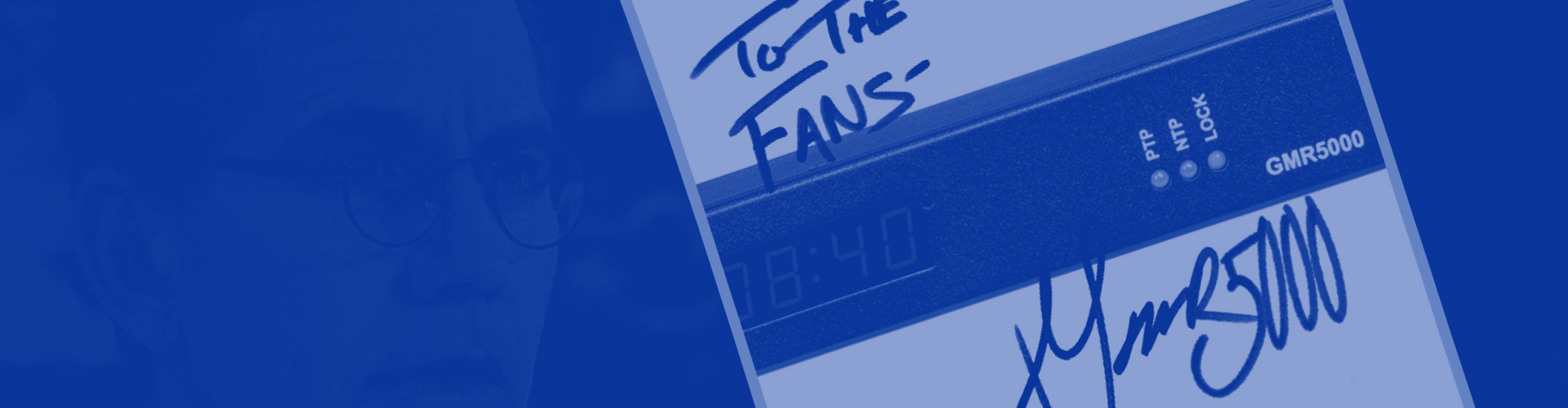
Playing the role of the USNO clock: the Masterclock GMR5000 time server.
Hines quickly schools NCIS Chief Medical Examiner Dr. Jimmy Palmer on the sensitive and critical role that this USNO Master Clock plays in all mission-critical applications, from power grids, to military command and control, to GPS. Any interference could have dire consequences.
“This clock is the only thing that the world agrees on” Hines tells Dr. Palmer. The team dives into investigation. And everybody starts talking TIME.
What was this suspect up to, tampering with time? If you like crime shows, and timekeeping, you’re in luck. The episode is available at CBS.com.
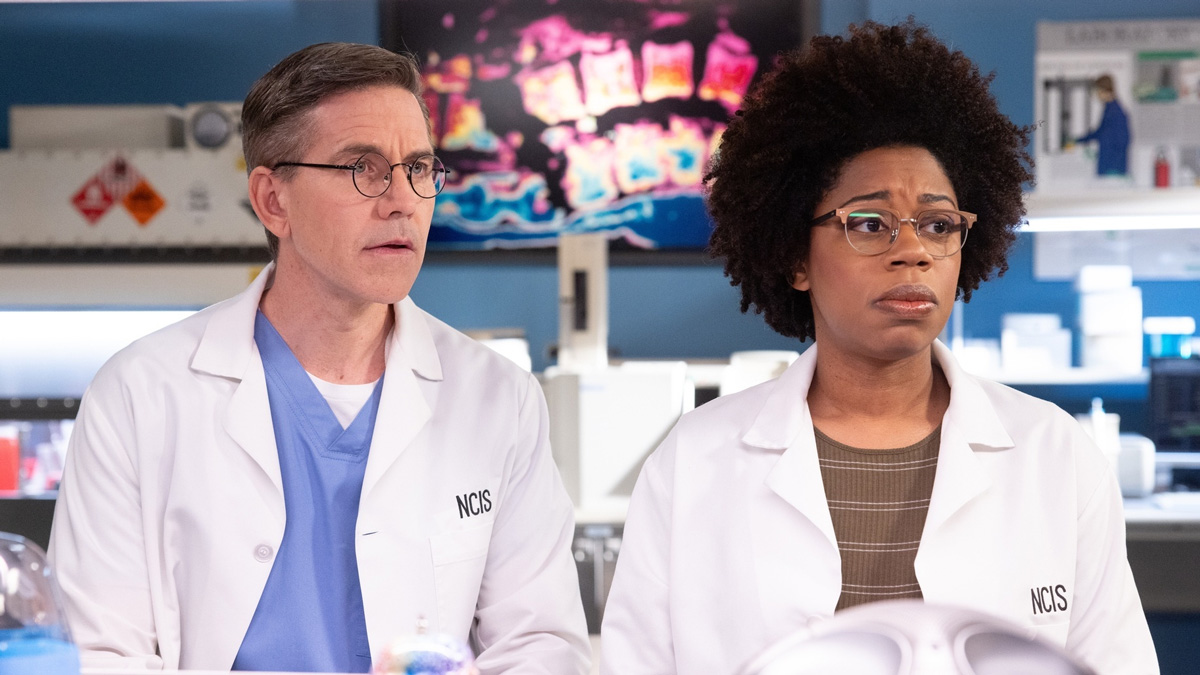
NCIS Chief Medical Examiner Dr. Jimmy Palmer and forensic scientist Kasie Hines look aghast as security footage reveals an intruder accessing the USNO’s master clock. Image courtesy of CBS / Paramount. From NCIS, episode “Stolen Moments.” Used for editorial purposes.
What NCIS Got Right (and Wrong) About Precision Timekeeping
In real life, the U.S. Naval Observatory (USNO) is in fact home to the Department of Defense’s ensemble of atomic clocks, which generate UTC(USNO), the authoritative reference time used to synchronize military systems, including GPS. Hines was accurate in describing just how critical this precise time is to our national infrastructure.1
The USNO still relies on Cesium-133 beam clocks, but modern timekeeping is largely driven by an expanded ensemble of hydrogen masers, with rubidium fountain clocks providing additional accuracy and calibration. This modernization began in the mid 1990s and continued through the early 2010’s, leading to significantly greater stability and precision in real-world timekeeping. The man who oversaw this modernization? Dr. Demetrios Matsakis.2
And while the Masterclock GMR5000’s performance was award-worthy, our time server plays a different but equally critical role off screen. The GMR5000 securely receives authoritative time from sources such as GPS and distributes high-precision time across complex operational networks.
There are some small technical inaccuracies as the NCIS team talks timekeeping3, but it’s all in good drama! And the episode is a reminder of a simple truth: from everyday technology to financial institutions to national defense—precision timekeeping underpins everything we rely on.
We thank these fictional investigators for their role in helping to keep our world in sync.
Footnotes
1
The intruder may have been best served tampering with UTC (NIST) vs UTC (USNO) (especially by selectively altering the actual time received by different financial institutions). While USNO provides the authoritative time reference for defense systems and GPS, NIST—located in Boulder, Colorado—serves as our nation’s primary civilian time authority, distributing UTC(NIST) through radio and internet services used by millions of everyday systems. If someone wanted to manipulate timestamps in stock trading systems, UTC(NIST) would be the relevant reference, not the Naval Observatory’s defense-oriented clocks. ↩
2
Before joining Masterclock, Dr. Demetrios Matsakis served as head of the USNO Time Service Department for 16 years. During Dr. Matsakis’ tenure he led improvements to the Observatory’s master clock, increasing its performance by a factor of five. These advancements strengthened our nation’s ability to generate, maintain, and distribute precise time—and enabled systems like GPS to perform at the level we rely on today. In 2022, Dr. Matsakis was honored with the Institute of Navigation Distinguished Service Award for his leadership and achievements at USNO. ↩
3
The decision for a globally agreed upon standard time occurred closer to 140 years ago, not 150, as Hines proclaimed to her NCIS counterpart. In 1884, the International Meridian Conference convened in Washington, D.C., with scientific leadership from the U.S. Naval Observatory, where 25 nations agreed to adopt a common prime meridian at Greenwich. This marked the first global agreement on a shared reference for time and longitude and established the foundation for UTC.
Later in the episode, NCIS investigators discover that the clock is off by 1/1,000 of a second (a "millisecond"), but accidentally refer to it as a "microsecond" (1/1,000,000 of a second).
Forensic scientist Hines checks the USNO’s time against the “International clock in Paris,” but no such clock exists. Paris is home to the BIPM (Bureau International des Poids et Mesures), which does not maintain its own clocks but instead compiles a reference timescale from national ensembles like USNO. In reality, Hines could compare UTC(USNO) to other national timescales such as UTC(NIST) out of Colorado; or UTC(PTB) in Germany; or cross-check time using other GNSS systems like Galileo, GLONASS, or BeiDou.
As far as the tampering of time going wholly unnoticed, Dr. Matsakis explains that in reality, internal and external quality control checks are in place to quickly reveal any tampering larger than a few nanoseconds (1/1,000,000,000 seconds), even if carried out by a department head who knew all the details and passwords of the USNO’s time generation. And USNO and NIST compare their time on daily basis.↩
Latest Scientific Editorial by Dr. Demetrios MatsakisHow We Modeled the GMR6000 Oscillator